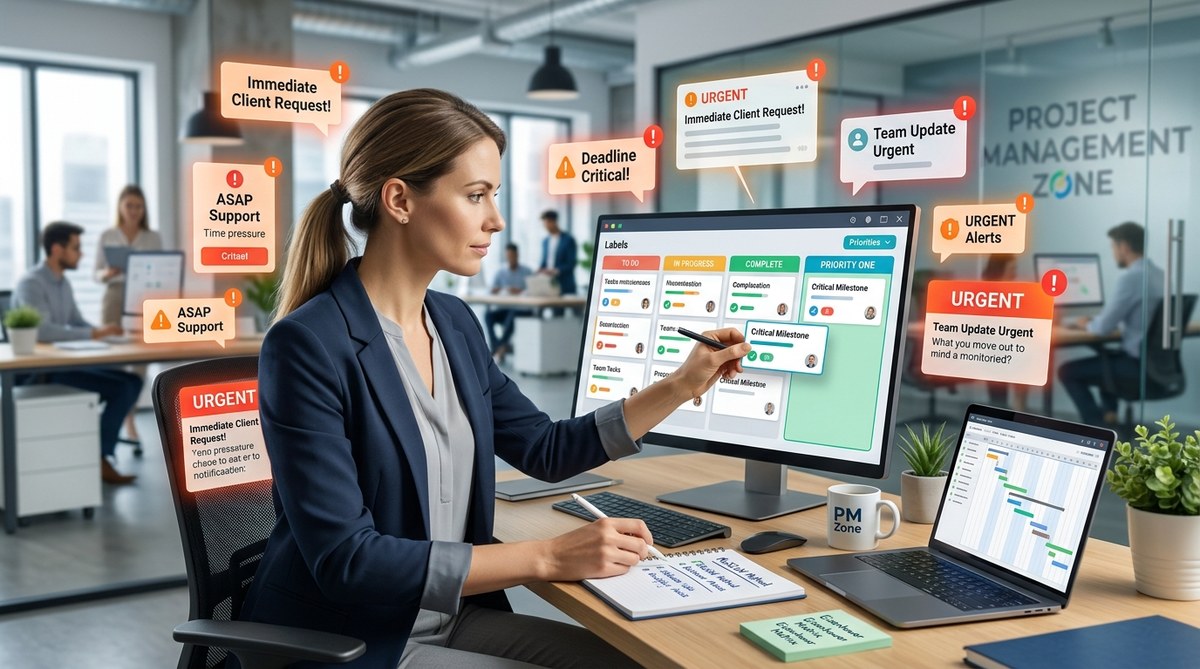
Your Slack channel is blowing up. Three stakeholders have marked you as “high urgency” in the same hour. Your inbox looks like a game of Tetris where every block is red. When everything feels urgent, the natural reaction is to freeze. Or worse, to start doing everything at once and finish nothing.
The truth is that urgency is often a feeling, not a fact. A client’s panic does not automatically make their request more important than your core deliverables. Learning how to prioritize tasks when everything is urgent is the skill that separates overwhelmed project managers from effective ones.
Urgency hijacks your brain into thinking everything needs to happen now. The fix is a repeatable framework that separates emotional noise from real deadlines. This article gives you a five step process, a comparison of popular methods, and a decision making table you can use today. Stop reacting and start choosing.
Why Your Brain Loves Urgency (and Why That Is a Problem)
Your brain is wired to respond to immediate threats. That is why a loud notification feels more pressing than a thoughtful plan. When you see a red “due today” label, your amygdala activates. You feel a rush of adrenaline. You drop everything to handle it.
This worked great when we needed to avoid predators. It works terribly when you need to ship a product roadmap by Friday.
The real challenge of task prioritization is not that you lack the tools. It is that your biology is working against you. Urgency creates a false sense of importance. A task that is truly urgent but low value can eat your entire morning if you let it.
The Five Step Process to Regain Control
Here is a repeatable process you can run when your task list looks like a disaster zone. Use these steps in order. Do not skip ahead.
-
Close all inputs. Shut down Slack notifications. Close your email tab. Put your phone face down. You cannot prioritize while new demands are still flooding in. Give yourself fifteen minutes of silence.
-
Write down every task that feels urgent. Do not filter yet. Just dump everything onto a page. This gets the urgency out of your head and onto paper where you can see it clearly.
-
Add a deadline and a consequence for each task. Next to each item, write the actual due date and what happens if you miss it. Is the consequence a delayed launch? A disappointed client? Or just an awkward email?
-
Sort by consequence severity, not by noise level. Rank the tasks based on the real world impact of missing the deadline. A task with a hard regulatory deadline ranks above a task with a “nice to have” deadline, even if the latter person is yelling louder.
-
Pick the top three and schedule them. Block time on your calendar for exactly three tasks. Everything else waits. If something truly urgent appears later, it must knock one of these three out. No stacking.
Comparing Popular Prioritization Methods
Different situations call for different frameworks. Here is a breakdown of the most effective methods for project managers in 2026.
| Method | Best For | Weakness | When to Use It |
|---|---|---|---|
| Eisenhower Matrix | Sorting urgent vs. important | Can feel vague without clear criteria | When you have a mix of operational and strategic tasks |
| MoSCoW (Must, Should, Could, Won’t) | Aligning a team on scope | Requires stakeholder buy in | During sprint planning or project kickoffs |
| Eat That Frog | Overcoming procrastination | Does not handle multiple urgent items | When one big task is blocking everything else |
| Effort vs. Impact Matrix | Deciding where to invest time | Needs data you may not have yet | When you are choosing between several good options |
| ABCDE Method | Daily personal productivity | Less useful for team level decisions | When you need a quick personal to do list filter |
Each method has a place. The mistake is using the same one every time. If you are in a crisis, the Eisenhower Matrix helps you breathe. If you are planning a quarter, MoSCoW keeps the team honest.
The One Question That Cuts Through the Noise
When you are stuck, ask yourself this single question:
“If I could only finish one thing today, which task would cause the most damage if left undone?”
This is not about what feels urgent. It is about consequence. The answer to that question is your real priority. Everything else is noise.
This question works because it forces you to think about failure modes. Project managers spend too much time chasing success and not enough time avoiding catastrophic failures. A delayed internal report is annoying. A missed compliance deadline can shut down a project.
Common Mistakes That Make Urgency Worse
Avoid these traps. They are the reason you feel stuck in the first place.
- Treating all stakeholder requests as equal. A VP of Product and an intern both have opinions. They do not carry the same weight. Learn to triage by authority and impact.
- Saying yes to everything to avoid conflict. Every yes is a no to something else. When you say yes to a low urgency request, you are stealing time from a high urgency task.
- Checking email first thing. Your inbox is a list of other people’s priorities. If you check it before you set your own, you lose the day before it starts.
- Multasking during prioritization. You cannot sort tasks while you are also answering a DM. Block ten minutes of alone time to do the sorting.
A Practical Example So You Can See It Work
Let us say you are managing a software launch. Your list looks like this:
- Fix a critical bug reported by the QA team (due today, blocks release)
- Review a new feature request from the CEO (due tomorrow, no real blocker)
- Prepare slides for the weekly status meeting (due in 3 hours, low consequence if brief)
- Respond to an angry client email (feels urgent, but the client is not churning)
Use the five step process. The bug is the only task with a real, immediate consequence. Block an hour to fix it. Then do the slides because the meeting is in three hours. The CEO request waits until tomorrow. The client email gets a polite “I will respond by end of day” reply.
This feels uncomfortable at first. The CEO’s request seems important. But the bug will stop the release. That is the harder consequence.
How to Build a Prioritization Habit That Lasts
A single session of prioritization helps for a day. A habit helps for a career. Here is how to make this stick.
- Set a daily “priority block” at the same time every morning. Make it non negotiable. Fifteen minutes is enough.
- Use a shared prioritization board with your team. Tools like Trello or a simple shared doc let everyone see what is actually important. This reduces the number of “urgent” requests you receive because the team self sorts.
- Review your week on Friday. What felt urgent but was not? What was important but got delayed? Use that data to adjust next week.
- Teach your stakeholders this language. When someone sends a request, ask them: “On a scale of one to five, what is the consequence of not doing this today?” Most people will pause and downgrade their own urgency.
If you want to go deeper on building efficient team habits, check out this guide on streamlining team workflows for better project outcomes. It pairs well with the prioritization process above.
When Everything Still Feels Urgent (The Emotional Side)
Even with the best framework, some days will still feel overwhelming. That is normal. Urgency is not just a scheduling problem. It is an emotional state.
When you feel the panic rising, pause. Take three slow breaths. Remind yourself that urgency is a signal, not a command. You get to decide what to do with that signal.
Your team looks to you for calm. If you are panicking, they will panic too. If you are steady and methodical, they will follow your lead. That is the real job of a project manager. Not just managing tasks, but managing the energy around those tasks.
Your Next Step
You do not need a complex system. You need a simple one that you will actually use.
Start tomorrow morning. Before you open Slack or email, write down your three most consequential tasks. Block time for them. Then open your notifications. See how different the day feels when you have already chosen your priorities before the world tries to choose them for you.
If you want to refine your approach further, take a look at these top agile techniques every project manager should know. They work especially well when your team is operating under constant time pressure.
You have more control than you think. The framework is just the starting point. The real power comes from choosing to use it.