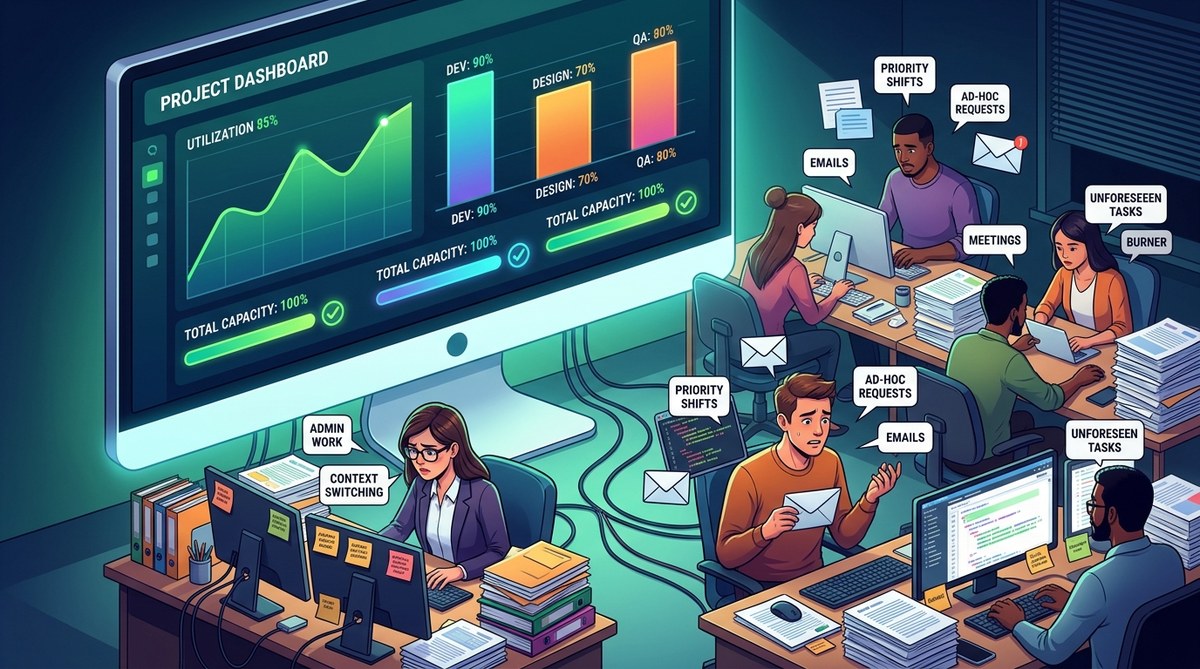
You are leading a project. The kickoff meeting went well. The team is motivated. The stakeholder bought lunch. Then week three hits, and everything starts slipping.
One task bleeds into another. A dependency you forgot about blocks the whole team. Suddenly your delivery date looks like a fantasy. This isn’t bad luck. It is almost always the result of one of a few predictable project planning mistakes that derail timelines.
The good news is these mistakes follow a pattern. Once you know what to look for, you can catch them before they cause damage.
Missed deadlines rarely happen because of lazy teams. They happen because of eight specific planning errors: vague goals, optimistic estimates, ignored risks, missing dependencies, poor resource allocation, scope creep, weak communication, and skipping progress checkpoints. Fix these eight things, and your delivery timelines will become predictable again.
The Eight Planning Mistakes That Kill Your Timeline
Let us walk through each mistake. For each one, you will get a clear sign that you are making it and a fix that works.
1. Starting With Vague Goals
If your project charter says something like “improve the customer experience” or “build a better dashboard,” you are already in trouble. Vague goals lead to vague plans. Vague plans lead to missed deadlines.
The fix: Write goals that pass the “so what” test. A goal like “reduce checkout time by 30 seconds” tells your team exactly what to build and how to measure success. Without that clarity, your team will spend cycles debating scope instead of shipping work.
2. Planning With Optimistic Estimates
We all do this. You ask a developer how long a task will take. They say three days. You mentally round down to two because you need to hit a deadline. Then the task takes five days.
Optimism bias is the single biggest driver of timeline failure. It is not malice. It is just human nature.
The fix: Use reference class forecasting. Look at how long similar tasks actually took in the past. If your team has never delivered a feature like this in under a week, do not plan for three days.
3. Ignoring Risk Identification
Most project plans are built on a single path. Everything goes right. Nobody gets sick. No vendor is late. No API changes.
A plan without risk identification is not a plan. It is a wish.
The fix: During planning, ask your team one question: “What would have to go wrong for us to miss this deadline?” Write down every answer. Then add buffer time for the top three risks. This is not pessimism. It is realism.
4. Missing Hidden Dependencies
Your team can finish their work on time. But they are blocked waiting for the design team. The design team is waiting for legal approval. Legal is waiting for the vendor contract.
Unmapped dependencies create a domino effect. One late input delays everything downstream.
The fix: Create a dependency map during the planning phase. For each task, ask “what needs to be true before we can start this?” List every single one. Then check those items weekly. If you want to learn more about structuring this process, read about master effective project planning strategies for seamless delivery.
5. Misallocating Resources
You put your best developer on the hardest task. That sounds smart, but now they are a bottleneck. Everything else waits for them.
Resource allocation is not just about who is available. It is about who is available at the right time.
The fix: Use a simple capacity plan. List every person on the team. Note their current workload. Then assign tasks based on availability, not just skill. If someone is already at 90 percent capacity, do not give them the critical path item.
6. Letting Scope Creep Slide
A stakeholder asks for “one small change.” It is just a button. It will take an hour. You say yes.
Then another request comes. Then another. Suddenly your two week sprint is a three month nightmare.
The fix: Every change request goes through a formal process. No exceptions. Use the table below to decide how to handle each one.
| Request Type | Action | Impact on Timeline |
|---|---|---|
| Cosmetic change | Defer to next phase | None |
| New feature | Require formal change order | Add 2 to 5 days |
| Requirement clarification | Accept if under 2 hours | None |
| Scope expansion | Reject or renegotiate deadline | Add 1 to 4 weeks |
7. Communicating Only at Milestones
You send a status update every two weeks. The team is fine. Then two weeks later, you find out the developer has been stuck on the same bug for ten days.
Silence is not progress. It is a warning sign.
The fix: Set a communication cadence that matches the risk level of the project. For high risk projects, do daily standups. For lower risk, do weekly check ins. The key is that nobody should be surprised at the end. Learn how to build a project meeting cadence that keeps work moving.
8. Skipping Progress Checkpoints
You plan for twelve weeks. You check in at week six. The team says they are on track. At week ten, you realize they are only 40 percent done.
This happens because people report status based on effort, not completion. “I am 80 percent done with the research” sounds good. But research is 20 percent of the work. The remaining 80 percent is implementation.
The fix: Define clear completion criteria for each phase. A task is not “almost done.” It is either done or not done. Use checkpoints every week to compare actual progress against the plan.
“The difference between a good plan and a bad plan is not how pretty it looks. It is how quickly you find out you are wrong.” — A project manager with 20 years of experience
A Practical Process to Avoid These Mistakes
You cannot fix all eight mistakes at once. That would overwhelm your team. Instead, use this three step process to tackle them one by one.
- Audit your last three projects. Look at each one and identify which of the eight mistakes caused the biggest delay. Write it down.
- Pick one mistake to fix. Choose the one that caused the most pain. Implement the fix from this article. Run one full project cycle with that fix in place.
- Measure the result. Did your timeline improve? If yes, pick the next mistake. If not, adjust the fix and try again.
This incremental approach works better than trying to overhaul your entire planning process overnight.
Tools That Help You Stay on Track
You do not need a complex tool to avoid these mistakes. You need a tool that makes the right information visible. Look for features that support:
- Dependency mapping
- Capacity planning
- Risk logging
- Real time progress tracking
If you want recommendations, check out our guide to top project management tools to boost your team’s efficiency. The right tool makes the planning process easier, but it will not fix a broken process.
Building a Culture That Respects Timelines
The last piece of the puzzle is culture. If your organization rewards heroic effort over realistic planning, you will keep missing deadlines.
Here is what a healthy planning culture looks like:
- People feel safe raising risks early
- Estimates are treated as ranges, not promises
- Stakeholders understand that changes cost time
- The team celebrates accurate forecasts, not just early deliveries
This does not happen overnight. But every time you catch one of these eight mistakes before it derails your timeline, you move a step closer to that culture.
Your Next Step
Pick the one mistake that hurts your projects the most. Write it down. Apply the fix from this article. Run your next project cycle with that single change.
Then come back and pick the next one.
You do not need to be perfect. You just need to be a little better than last time. That is how delivery timelines stop slipping.