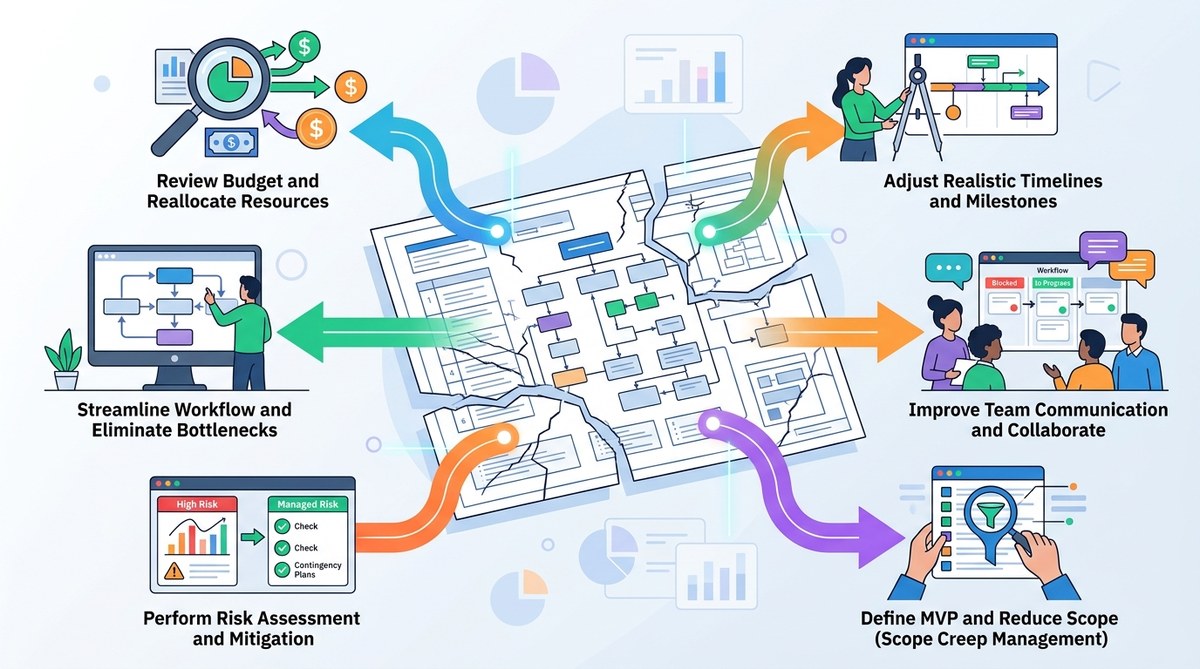
You have a project plan that is falling apart. Deadlines are slipping, the budget is leaking, and your team is frustrated. You might be tempted to scrap everything and start from scratch. Do not do that. Starting over wastes time, erodes trust, and often repeats the same mistakes. The better path is to fix a broken project plan using targeted corrections. Here is how to salvage your plan without hitting the reset button.
A broken project plan does not need a full rewrite. You can fix it by diagnosing the real problem, resetting priorities, and adjusting your schedule with buffer time. Focus on communication, remove unnecessary tasks, and use a simple recovery checklist. These six methods help you get back on track without losing the work you have already done.
Find the Real Problem First
Before you change anything, you need to understand what broke. Many teams skip this step and start moving tasks around. That is like treating a fever without knowing if it is the flu or food poisoning.
Start with a short root cause analysis. Gather your core team for a 30 minute meeting. Ask three questions:
- What was supposed to happen?
- What actually happened?
- What is the gap between those two things?
Look for patterns. Did a single dependency fail? Did a stakeholder change requirements without notice? Did you underestimate the time for a key task? Write down the answers. This diagnosis becomes your guide for the rest of the fixes.
Common reasons plans break include:
- Unrealistic time estimates
- Scope creep that was never formally approved
- Poor communication between teams
- A single point of failure in your critical path
- Lack of buffer time for unexpected issues
Once you know the root cause, you can choose the right fix. Do not try to fix everything at once. Pick the one or two issues that caused the most damage.
Reset Priorities with a Simple Framework
When a plan is broken, everything feels urgent. Your job is to bring order back. Use a priority matrix to sort what matters.
Create a simple table with your team. List every remaining task and score it on two axes: impact on the project goal and effort required.
| Task Type | High Impact | Low Impact |
|---|---|---|
| High Effort | Do these first if they block others | Consider cutting or deferring |
| Low Effort | Do these immediately | Do these if time allows |
Focus your energy on the high impact, low effort tasks first. They give you momentum. Then tackle the high impact, high effort items. Anything that is low impact and high effort is a candidate for removal.
This process helps you fix a broken project plan by cutting the noise. You stop doing work that does not move the needle. Your team will feel the relief of a clearer focus.
Renegotiate the Timeline (Do Not Guess)
A common mistake is to tighten the schedule to make up for lost time. That usually backfires. If your plan is already off track, compressing the timeline without changing scope or resources will break it further.
Instead, look at your remaining work and build a realistic schedule. Use these steps:
- List all remaining tasks in order.
- Estimate the time for each task based on how long similar tasks actually took, not how long you hope they will take.
- Add a buffer for each task. A good rule is 15 to 20 percent extra for tasks with medium risk, and 30 to 40 percent for high risk tasks.
- Identify your critical path. That is the longest chain of dependent tasks. Protect it.
- Present the new timeline to stakeholders with clear reasoning. Show them the old estimate, the actual performance, and the adjusted forecast.
Be honest about what caused the delay. Stakeholders respect transparency more than they respect a fake optimistic date. If you need to push the final deadline, say so now. Waiting will only make it worse.
For more on building schedules that hold up, read our guide on how to create a project schedule that survives contact with reality.
Cut Scope That Does Not Add Value
Scope creep is one of the biggest reasons plans fail. But once you are in recovery mode, you have permission to cut. Not everything you planned is still necessary.
Review your project charter or original goals. Ask your stakeholders what the absolute minimum is for a successful delivery. Then remove everything else.
Create a list of features, deliverables, or tasks that are nice to have but not essential. Move them to a separate backlog. You can revisit them after the main project is delivered.
This is one of the hardest steps because people get attached to their ideas. But if you want to fix a broken project plan, you must be ruthless about scope. A smaller project delivered on time is better than a large project that never ships.
Consider using a technique called MoSCoW. It stands for Must have, Should have, Could have, and Will not have. Use it to categorize every remaining task. Anything in the “Will not have” category gets removed from the plan.
Improve Communication and Accountability
A broken plan often has a broken communication loop. People do not know who owns what. Status updates are vague. Decisions take too long.
Fix this by clarifying roles and responsibilities. Use a RACI chart if you do not already have one. RACI stands for Responsible, Accountable, Consulted, and Informed. Every task should have one person who is accountable for its completion.
Set a regular check in cadence. This does not mean more meetings. It means better meetings. Try a daily 15 minute stand up where each person answers:
- What did I do yesterday?
- What will I do today?
- What is blocking me?
Keep these short. No detailed discussions. If a blocker comes up, handle it after the stand up with only the relevant people.
For teams that are distributed or working async, consider using video updates. Learn how to turn async video updates into usable project documentation to keep everyone aligned without scheduling conflicts.
Use a Recovery Checklist to Stay on Track
Once you have applied the fixes above, you need a way to prevent the plan from breaking again. A simple recovery checklist helps you monitor progress and catch issues early.
Here is a checklist you can use each week until the project is back on track:
- Are we hitting the revised milestones? If not, why?
- Is the scope still under control? Any new requests?
- Are team members reporting blockers?
- Do we have enough buffer time left for the remaining high risk tasks?
- Have we communicated the latest status to stakeholders?
Print this checklist or add it to your project management tool. Review it in your weekly team meeting. If you answer “no” to any of these questions, take action immediately.
This is not about micromanaging. It is about staying aware. A project that is recovering needs more attention than a project that is running smoothly. That is normal. Give it the focus it needs for a few weeks, and it will stabilize.
For a deeper look at managing team capacity during recovery, check out what your project dashboard is not telling you about team capacity.
When to Ask for Help
Sometimes you cannot fix a broken project plan alone. If the issues are systemic or you lack the authority to make necessary changes, escalate.
Ask your sponsor or senior leadership for:
- Additional resources (people, budget, or tools)
- Help with stakeholder management
- Permission to cut scope
There is no shame in asking for help. In fact, it shows that you understand the situation and are being proactive. Waiting until the project is completely derailed only makes the recovery harder.
If you need to have a difficult conversation about a missed deadline, our guide on what to do when your team misses a deadline provides a practical recovery plan.
Putting It All into Action
You now have six ways to fix a broken project plan without starting over. The key is to act quickly and focus on the highest impact changes. Do not try to do all six at once. Pick the one that addresses your root cause and start there.
Here is a summary of the steps:
- Diagnose the real problem before making changes.
- Reset priorities using a simple impact versus effort table.
- Renegotiate the timeline with honest estimates and buffer time.
- Cut scope that does not add value to the core goal.
- Improve communication with clear roles and a regular cadence.
- Use a recovery checklist to monitor progress weekly.
Each of these steps is designed to save the work you have already done. You do not need a blank page. You need a clear head and a willingness to make hard choices.
Your Project Can Recover
Seeing a plan go off track is stressful. But it does not mean the project is doomed. Many successful deliveries started as broken plans that were corrected mid course. The difference between failure and recovery is how you respond.
Take a breath. Gather your team. Use the methods in this article to stabilize your plan. You have the skills to do this. Trust your experience, and do not be afraid to adjust as you go.
If you want to strengthen your planning skills for future projects, read about master effective project planning strategies for seamless delivery. The lessons you learn from fixing a broken plan will make your next plan stronger.
Start today. Pick one fix, apply it, and watch your project move from crisis to control.