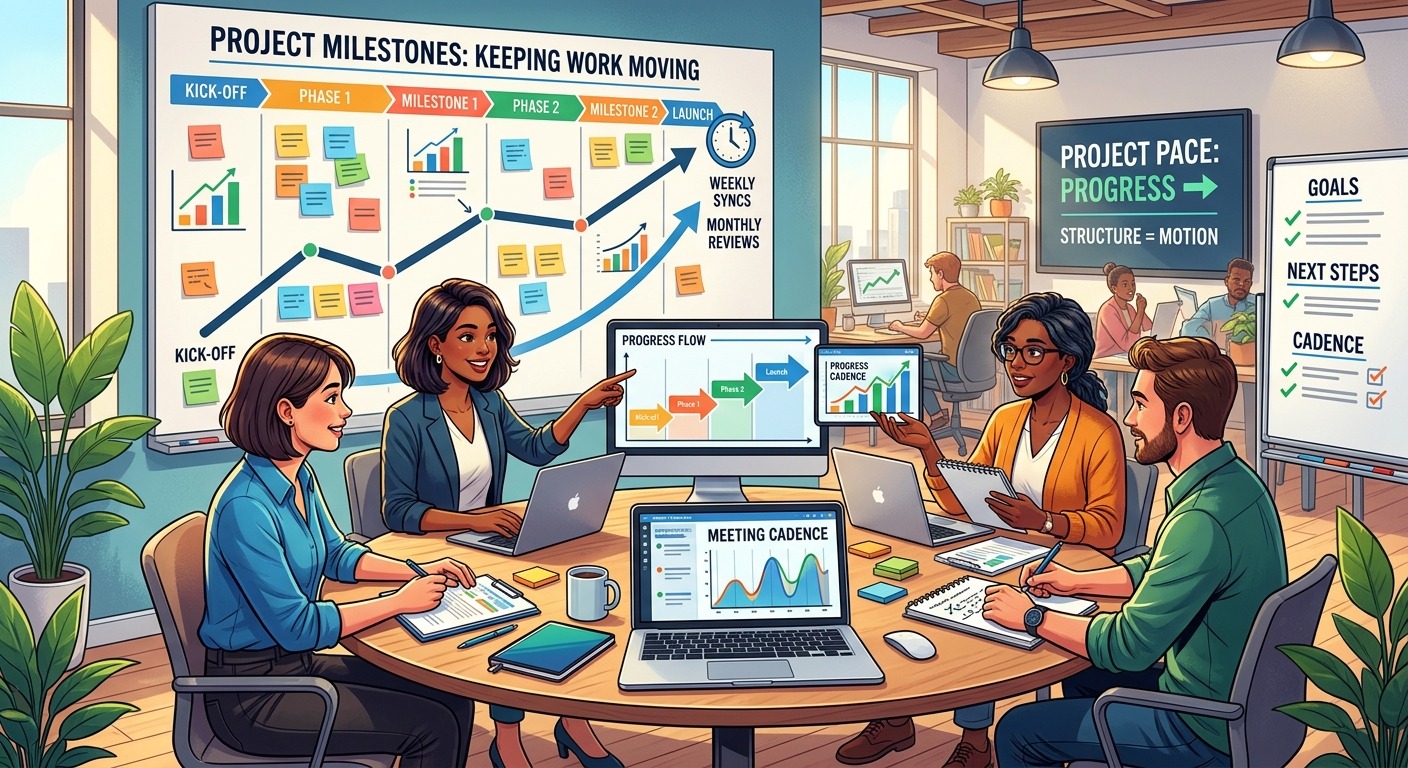
Bad meeting habits are one of the fastest ways to derail a project. Not because meetings are inherently wasteful, but because random, unplanned meetings eat into focus time without giving teams the structural rhythm they actually need. A deliberate cadence fixes that. It tells everyone what to expect, when to show up, and what decisions will happen where. Get the cadence right, and your project practically steers itself between sessions.
Meeting Cadence at a Glance
A strong project meeting cadence combines four core session types: daily standups for team visibility, sprint planning for commitment, stakeholder check-ins for business alignment, and retrospectives for continuous improvement. Match the frequency of each to your delivery phase, keep attendance lists intentionally tight, and protect recurring time slots from calendar drift. Scheduling automation removes the coordination tax that quietly erodes even the most well-designed cadence before it has a chance to take hold.
Why Most Teams Get Their Meeting Rhythm Wrong
Most teams fall into one of two traps. The first is meeting overload: syncs stacked on top of syncs, with no clear purpose behind any of them. The second is under-meeting, where teams rely on chat messages and hope, then discover misalignment two weeks too late.
Neither approach gives project managers the control they need. A cadence is not just a schedule. It is a communication architecture. Each meeting type handles a specific job, and together they form a feedback loop that keeps work visible, risks surfaced, and stakeholders informed. Without that architecture, teams spend more time reacting than delivering.
The Four Meeting Types That Form a Solid Cadence
Before you can schedule anything, you need to know what each meeting type is actually for. Conflating them is where most cadences fall apart. Here is what each one does and how long it should run.
Daily Standups
The standup is the team’s daily pulse check. It should never run longer than fifteen minutes. The goal is to surface blockers fast, not to provide a status report to the project manager. Each team member answers three things: what they worked on yesterday, what they are working on today, and what is in their way.
Keep it standing, or video-on for remote teams. That physical or visual prompt reinforces that this is a brief, focused check-in, not a discussion session. If something needs a longer conversation, park it for after the standup ends. Anything that runs past fifteen minutes is no longer a standup.
Sprint Planning
Sprint planning happens at the start of every sprint cycle, typically once every one to two weeks depending on your sprint length. This is where the team commits to a realistic set of work items from the backlog. The product owner or project lead prioritizes; the team sizes and selects what they can genuinely finish.
A solid sprint planning session produces a sprint goal and a committed backlog. Formal guidance on sprint planning structure frames this around two core questions: what the sprint can deliver, and how the chosen work gets done. Budget one to two hours for a two-week sprint, and do not let planning bleed into a half-day affair.
Stakeholder Check-ins
These happen less frequently, typically once per sprint or once every two weeks. The purpose is to show progress, gather feedback, and surface any shifting priorities before they become problems mid-delivery. Stakeholders should see working output, not slide decks full of status updates. Real demos build more trust than any report ever could.
Keep the invite list tight. Include decision-makers and key sponsors. Skip the people who only need to be informed, and send them a written summary afterward instead.
Retrospectives
The retrospective closes each sprint. It is the team’s chance to reflect on what worked, what did not, and what to change in the next cycle. Keep this session psychological-safety-first. The goal is honest conversation, not blame distribution.
Limit it to ninety minutes for a two-week sprint. A good retrospective surfaces one to three actionable improvements the team commits to trying next time. More than three and nothing sticks. Specificity beats volume every time.
Who Belongs in Each Session
One of the fastest ways to ruin a cadence is inviting the wrong people to everything. Attendance bloat turns focused meetings into committee sessions where nothing gets decided. Here is who should be in each meeting type:
- Daily standup: Core delivery team only. No sponsors, no silent observers unless they are actively contributing to delivery work.
- Sprint planning: The project manager or scrum master, the product owner or business lead, and the full delivery team. Everyone who commits to work needs to be in the room.
- Stakeholder check-in: Executive sponsors, key business stakeholders, and the project manager. The delivery team may demo but does not need to stay for the full session.
- Retrospective: The delivery team and project manager only. Stakeholders should not attend, as their presence changes the dynamic and stifles the honest feedback that makes retros valuable.
Respecting these boundaries takes discipline at first. Over time, it signals to everyone that their time is valued and their presence is intentional, not accidental.
Matching Meeting Frequency to Your Delivery Phase
Not every sprint looks the same. Your meeting cadence should flex based on where you are in the project lifecycle. Frequency is not a fixed setting; it is a dial you adjust as delivery conditions shift. Here is how the cadence changes across the three main phases.
Sprint Cadence Frequency by Delivery Phase
| Delivery Phase | Standup | Sprint Planning | Stakeholder Check-in | Retrospective |
|---|---|---|---|---|
| Planning Phase | 2-3x per week | Once, at kick-off | Weekly | Not applicable |
| Execution Phase | Daily | Start of each sprint | Every sprint | End of each sprint |
| Closing Phase | 2-3x per week | Not applicable | Final sign-off | Project retrospective |
During the planning phase, daily standups often feel excessive. The team is still forming and tasks are still being defined. Dropping to two or three times per week keeps momentum without burning out the team before delivery even begins.
The execution phase is where the full cadence fires. Daily standups, sprint planning, stakeholder demos, and retrospectives run in a tight, repeating loop. This is the engine room of delivery, and every session feeds the next.
As the project moves into closing, the team shifts focus from building to wrapping up loose ends, documentation, and handover. The cadence lightens again, with a final retrospective capturing lessons learned for future projects.
Cutting the Scheduling Overhead That Slows Teams Down
Even a perfectly designed cadence can collapse under the weight of scheduling friction. Getting twelve people into the same virtual room twice a week is harder than it sounds when calendars are fragmented across time zones, departments, and competing deadlines.
This is where automation earns its place. Using a project meeting scheduler takes the manual coordination out of recurring invites. Instead of chasing availability, the tool handles the back-and-forth automatically, surfaces open time slots, and sends confirmations without anyone lifting a finger. For teams running multiple concurrent projects, this alone can recover hours of coordinator time each week without any loss of meeting quality.
The other piece of scheduling discipline is setting standing times and protecting them. A standup that moves around the calendar is a standup people stop attending. Pick a time, lock it in, and treat it like a non-negotiable. Teams that protect their cadence slots deliver more consistently than teams that stay flexible about when meetings happen.
Signs Your Meeting Cadence Is Actually Working
You will know your cadence is doing its job when the conversations inside each meeting are sharp, focused, and finish on time. Beyond that, here are reliable signals that your structure is holding:
- Blockers surface in the standup and get resolved before they affect sprint delivery.
- Sprint planning sessions produce a committed, realistic backlog without long debates about scope creep.
- Stakeholders rarely send surprise requests mid-sprint, because the regular check-in gives them a predictable outlet for input.
- Retrospectives surface real process issues, and the team actually changes something the following sprint rather than talking and repeating.
- Meetings end on time, and attendees leave feeling like their presence was worth the hour.
If any of these signals are missing, the cadence itself is usually not the root problem. Look first at meeting preparation. Agendas sent late, no pre-read material, and unclear decision rights will sink even the best-structured schedule.
A Copy-Ready Template Tied to Your Sprint Cycle
Use this as your starting point. It is built around a standard two-week sprint and can be adapted for one-week or three-week sprints by compressing or stretching the frequency of planning and retrospective sessions accordingly.
Week 1, Monday: Sprint planning, ninety minutes. Full team, product owner, and project manager. Set the sprint goal and confirm backlog commitments before anyone writes a line of code.
Week 1, Tuesday through Friday: Daily standup, fifteen minutes. Core team only. Surface blockers fast and keep the conversation moving forward.
Week 1, Thursday or Friday: Stakeholder check-in, thirty to forty-five minutes. Demo working output from the previous sprint if there is something to show. No slides. Real output only.
Week 2, Monday through Thursday: Daily standup, fifteen minutes. Core team only. Same format, same discipline, same clock.
Week 2, Friday: Sprint retrospective, sixty to ninety minutes. Core team and project manager. What worked? What changes next sprint? Commit to one to three specific actions before the meeting ends.
Repeat the cycle. As the project matures, the cadence becomes automatic. Teams stop thinking about when to meet and start thinking about the work itself, which is exactly where their attention belongs.
When the Cadence Clicks, Delivery Follows
A meeting cadence is not about meetings. It is about predictability, trust, and visible progress. When your team knows when decisions happen, when blockers get escalated, and when stakeholders weigh in, the uncertainty that causes mid-project chaos fades into the background.
Start with the four core meeting types. Assign the right people to the right sessions. Match frequency to your delivery phase and protect your time slots with the same discipline you bring to a project deadline. The cadence will not run itself in the early sprints, but once it is running, it becomes the single most reliable engine for keeping work moving from day one to final handover. Build it once, and it pays dividends for every project that follows.