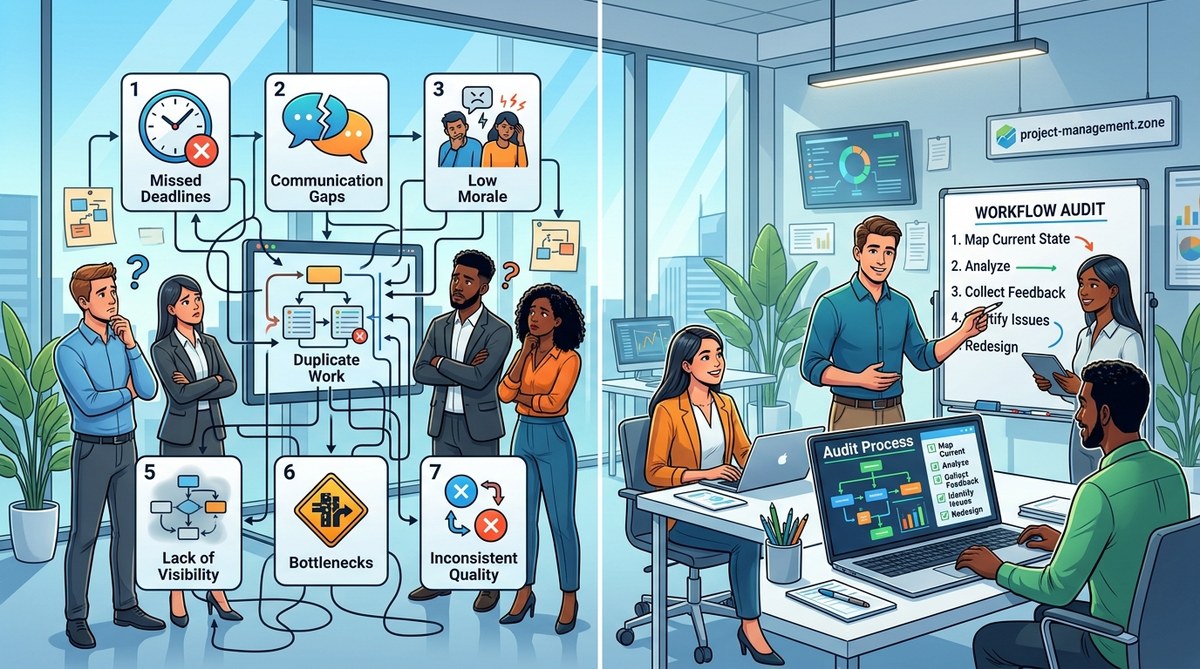
Every project manager has felt that cold moment when a blocker appears out of nowhere. One team finished their work on time, but the other team was waiting for an output that never arrived. The domino effect hits schedules, budgets, and team morale. Managing cross-team dependencies is the single most important skill for keeping complex projects on track. Without a structured approach, you end up firefighting instead of delivering.
Cross-team dependencies are inevitable in complex projects, but they don’t have to derail your delivery. This guide provides a repeatable framework to identify, map, and resolve dependencies before they become blockers. You’ll learn practical processes, common mistakes to avoid, and how to build a culture of shared ownership across teams.
Why Dependencies Become the Silent Project Killer
Dependencies are not the enemy. They are natural connections between teams that need to share data, code, design assets, or approvals. The problem is that most teams treat dependencies as afterthoughts. They surface during a status meeting three weeks after the work started. By then, the schedule is already broken.
A dependency becomes a blocker when it is invisible. When no single person owns the connection between Team A and Team B, both teams assume the other will handle it. This assumption is where projects go to die.
The goal is not to eliminate dependencies. The goal is to make them visible, owned, and timeboxed.
The Three Types of Cross-Team Dependencies You Must Track
Before you can manage dependencies, you need to recognize them. Here are the three categories that appear in almost every complex project.
Resource Dependencies
These happen when two teams need the same person, tool, or budget. A shared QA engineer. A staging server. A compliance reviewer. When the resource is in high demand, teams wait in line.
Technical Dependencies
These are the most common in software projects. Team A needs to finish an API endpoint before Team B can build the frontend. Team C needs to deploy a database migration before Team D can run their analytics pipeline. Technical dependencies follow a strict order.
Business Process Dependencies
These involve approvals, legal reviews, or procurement cycles. Marketing needs signoff from legal before launching a campaign. Engineering needs security approval before deploying to production. These are often the slowest dependencies because they involve external stakeholders.
If you are struggling to identify which dependencies are causing delays, read our guide on what your project dashboard isn’t telling you about team capacity.
A Step-by-Step Process for Managing Cross-Team Dependencies
This is a repeatable process you can use on any project. It works whether you are using Agile, Waterfall, or a hybrid approach.
Step 1: Map Dependencies Before the First Sprint
Do not wait until teams are already working to find dependencies. Hold a dependency mapping session during the planning phase. Invite representatives from every team that will touch the project. Use a whiteboard or a shared digital canvas.
For each major deliverable, ask three questions:
– What do we need from another team to complete this?
– What does another team need from us?
– What happens if this item is delayed?
Write every answer on a sticky note. Group them by type. This single session will reveal half of your hidden dependencies.
Step 2: Assign a Dependency Owner for Each Link
Every dependency needs a named owner. Not a team. Not a distribution list. A single person who is responsible for tracking the status and escalating blockers.
The dependency owner does not have to do the work. They just have to ensure the handoff happens on time. This role is often overlooked, but it is the difference between a dependency that resolves smoothly and one that turns into a crisis.
Step 3: Create a Dependency Register
A dependency register is a living document that lists every cross-team dependency in your project. It should include:
- The two teams involved
- The dependency type (resource, technical, or business process)
- The target completion date
- The dependency owner
- The current status (not started, in progress, blocked, resolved)
Update this register every week. Review it during your regular project sync. If a dependency has not changed status in two weeks, escalate it.
Step 4: Build Handoff Agreements
A handoff agreement is a simple contract between two teams. It defines exactly what will be delivered, in what format, and by when. It also includes a definition of done for the handoff.
For example, instead of saying “Team A will provide the API”, a handoff agreement says “Team A will provide a REST API with three endpoints, including documentation and a test suite, by Friday at 5 PM ET.”
This removes ambiguity. Both teams know exactly what to expect.
Step 5: Use Visual Dependency Tracking
A list of dependencies is useful, but a visual map is better. Use a Gantt chart, a dependency graph, or a Kanban board with swimlanes for each team. The visual representation helps everyone see the critical path.
When a dependency changes, the visual map updates immediately. This prevents the “I didn’t know you were waiting for me” conversation.
For more on improving team coordination, check out streamlining team workflows for better project outcomes.
Common Mistakes When Managing Cross-Team Dependencies
Even experienced project managers make these errors. Here is a table of the most common mistakes and how to avoid them.
| Mistake | Why It Happens | How to Fix It |
|---|---|---|
| Assuming dependencies are obvious | Teams work in silos and don’t communicate early | Hold a dependency mapping session before the project starts |
| No single point of ownership | Everyone assumes “someone else” is tracking it | Assign a named dependency owner for every link |
| Ignoring external dependencies | Internal teams are visible, but vendors or legal are invisible | Track external dependencies in the same register with earlier deadlines |
| Treating dependencies as static | Dependencies change as the project evolves | Review the dependency register weekly and update it |
| Failing to plan for delays | Every dependency has a risk of slipping | Add buffer time to every dependency handoff |
How to Communicate Dependencies Across Teams
Communication is the glue that holds dependency management together. But you do not need more meetings. You need better communication structures.
Use a Shared Dependency Dashboard
Create a dashboard that shows the status of every dependency. Make it visible to all teams. Use traffic light colors: green for on track, yellow for at risk, red for blocked. This transparency reduces surprises.
Establish a Dependency Sync Cadence
Hold a 15 minute dependency sync twice per week. Invite only the dependency owners. No status updates. Just a single question: “Is anything blocking your dependency?” If the answer is no, the meeting ends early. If the answer is yes, spend the rest of the time solving it.
Document Async Updates
Not everyone can attend every sync. Record a short video update or post a written summary in your project management tool. This keeps remote team members and different time zones aligned.
Learn how to turn async video updates into usable project documentation to keep everyone informed without adding meeting fatigue.
Building a Culture of Dependency Awareness
Processes and tools only work if the team culture supports them. You need to create an environment where people naturally flag dependencies before they become problems.
Reward Early Flagging
When someone raises a dependency early, thank them publicly. Do not treat it as a problem. Treat it as good news. The earlier a dependency is known, the easier it is to resolve.
Make Dependency Tracking Part of Onboarding
Every new team member should learn how to identify and log dependencies. Include it in your onboarding checklist. This ensures that dependency awareness becomes a habit, not an afterthought.
Run Dependency Retrospectives
After a major release or milestone, hold a retrospective focused specifically on dependencies. Ask:
– Which dependencies did we miss?
– Which dependencies were overengineered?
– What would have made handoffs smoother?
Use the answers to improve your process for the next project. If your current retrospectives feel unproductive, read why your retrospectives feel like a waste of time (and how to fix them in 2026).
Tools and Techniques That Make Dependency Management Easier
You do not need expensive software to manage dependencies. But the right tools reduce friction.
Use a Dependency Matrix
A dependency matrix is a grid that shows the relationship between every team and every deliverable. Each cell shows whether a dependency exists, who owns it, and its status. This is especially useful for projects with more than five teams.
Automate Dependency Alerts
If your project management tool supports automation, set up alerts when a dependency status changes. For example, when a task moves to “in progress”, automatically notify the dependent team. This removes the need for manual check-ins.
Create Dependency Templates
Build a template for handoff agreements. Include fields for deliverable description, format, deadline, and acceptance criteria. Reuse this template across projects. It saves time and ensures consistency.
For a broader look at tools that improve planning, see our list of top project management tools to boost your team’s efficiency.
A Practical Example: Managing Dependencies at Scale
Imagine you are running a project to launch a new mobile app feature. You have four teams: backend, frontend, design, and QA.
The backend team needs to build an API. The frontend team needs to build the user interface. The design team needs to finalize the mockups. The QA team needs to test everything.
Here is how the dependency management process plays out.
Mapping session: The teams identify that the frontend team needs the API endpoints before they can start coding. The QA team needs the frontend build before they can run tests. The design team needs to hand off mockups to both backend and frontend.
Dependency register: You create entries for each link. You assign owners. The design lead owns the mockup handoff. The backend lead owns the API delivery. The frontend lead owns the UI build.
Handoff agreements: The design team agrees to deliver mockups in Figma by Tuesday. The backend team agrees to deliver the API with documentation by Friday. The frontend team agrees to deliver a staging build by the following Wednesday.
Weekly syncs: Every Monday and Thursday, the dependency owners meet for 15 minutes. They update the register. They flag any risks.
Result: When the design team is delayed by a day, the dependency owner escalates it immediately. The backend team adjusts their schedule. The project stays on track.
This approach works because it is proactive, not reactive.
Keeping the Momentum Going
Managing cross-team dependencies is not a one time activity. It is a continuous practice that requires attention every week. The teams that do it well treat dependencies as first class citizens in their project planning. They do not hide them. They expose them, own them, and resolve them.
Start with the mapping session. Create your first dependency register. Assign owners. Build handoff agreements. The first time you do this, it will feel like extra work. But after one project cycle, you will see the difference. Fewer blockers. Smoother handoffs. Less stress.
Your project will still have dependencies. But they will no longer control your schedule. You will control them.
If you want to go deeper into improving team workflows, read about optimizing team workflows to accelerate project delivery. It pairs naturally with the dependency management framework you just learned.
Your Next Move for Smoother Team Coordination
Pick one dependency from your current project that you have been ignoring. Map it. Assign an owner. Set a handoff date. Do it today. That single action will save you hours of firefighting later. Then repeat the process for the next dependency. Over time, managing cross-team dependencies becomes a habit that protects your delivery timeline and your team’s sanity.